Skip to content
Red Hawk RoboticsGarage robotics lab proposal

Research and case studies

How successful teams practice

We looked at where top FRC teams build and drive, how much space they use, and what they spend.

What we found

Field access

Nearly every top team practices on a full field regularly, but few have one inside their school. Those that do usually got it through a district facility funded by a bond or state grant.

Floor space

A full field with room around it needs about 2,800 sq ft, and a working shop about 3,000 sq ft. Single-school facilities at top programs run 6,500–7,800 sq ft. The field sets the size, whatever the enrollment.

Budgets

Competitive district teams typically spend $50,000–80,000 a year, and world-level programs $150,000 or more. Most of it goes to registration and travel, not the robot.

No public dataset tracks FRC team facilities, so these findings come from published examples, not a representative sample. We plan to survey teams across the U.S. to fill the gap.

Case studies

Teams get field time in one of three ways. Mentors note that practicing on a full field is something most teams can't do in-house.

Inside the school or district

The model this proposal follows. Each example was built as a district facility, usually funded by a bond or state grant.

1678 Citrus CircuitsDavis, CA

A 7,800 sq ft engineering and robotics center at Davis Senior High with a practice field, completed in 2023. A $3M state CTE facilities grant was matched by a local bond; total cost was reported at about $6M. The team has about 90 students.

CA Dept. of EducationABC10

1323 MadTown RoboticsMadera, CA

2026 world champions, their fourth title. The team moved into a new building on the Matilda Torres High School campus and draws students from three district high schools.

Madera TribuneMadera County EDC

180 S.P.A.M.Stuart, FL

A 6,500 sq ft space at the Martin County school district offices with a full-size competition field. The team hosts other teams there.

Team website

Fremont Union High School DistrictCupertino, CA

A 14,500 sq ft robotics center at Cupertino High serving five campuses and up to 900 students, with a field and spectator seating. Funded by a 2022 bond and opened in September 2026. A multi-school center, not a single-school comparison.

HoodlineTHE Journal

Off-site, team-controlled

Teams without school space rely on sponsors, rented buildings, or their own nonprofit.

195 CyberKnightsSouthington, CT

2024 New England District champions. Based at Southington High but largely self-funded, with a practice field in space donated by a sponsor.

PatchCT Senate Republicans

6328 Mechanical AdvantageLittleton, MA

A community team run by a 501(c)(3) and drawing from several schools. It works out of a commercial R&D building.

Team website

Team 299

A mentor reports paying about $30,000 a year in rent for team space.

Chief Delphi

Shared or makeshift

Teams book time on another group's field or share a room with other school uses.

WPI Community Practice FieldWorcester, MA

A full-scale field open to all FRC teams by advance sign-up since 2023. It is the nearest shared field to Melrose.

WPI

Choate RoboticsWallingford, CT

An FRC practice field in a gym shared with the archery team.

Choate Robotics

6329 The Bucks' WrathBucksport, ME

A small rural school that reached the Einstein finals in 2023 and 2026, supported by a $250,000 alumni STEM donation. Facility details were not found.

Bangor Daily News

How much space a field needs

SpaceSq ftBasis
Typical classroom (reference)≈ 900Rule of thumb
Half field with margins≈ 1,000–1,400About 27 × 27 ft of carpet plus margins
Full field, carpet only≈ 1,45827 × 54 ft; varies slightly by season
Full field with driver stations and equipment≈ 2,800About 40 × 70 ft, per Chief Delphi
Working shop≈ 3,000One team's planned shop, per Chief Delphi
180 S.P.A.M. facility6,500Team website
1678 Citrus Circuits facility7,800CA Dept. of Education
Fremont Union HSD center (five schools)14,500News coverage

Chief Delphi threads: Full-field practice facilities · Smallest possible practice field · Ideal robot workspace

How our plan compares

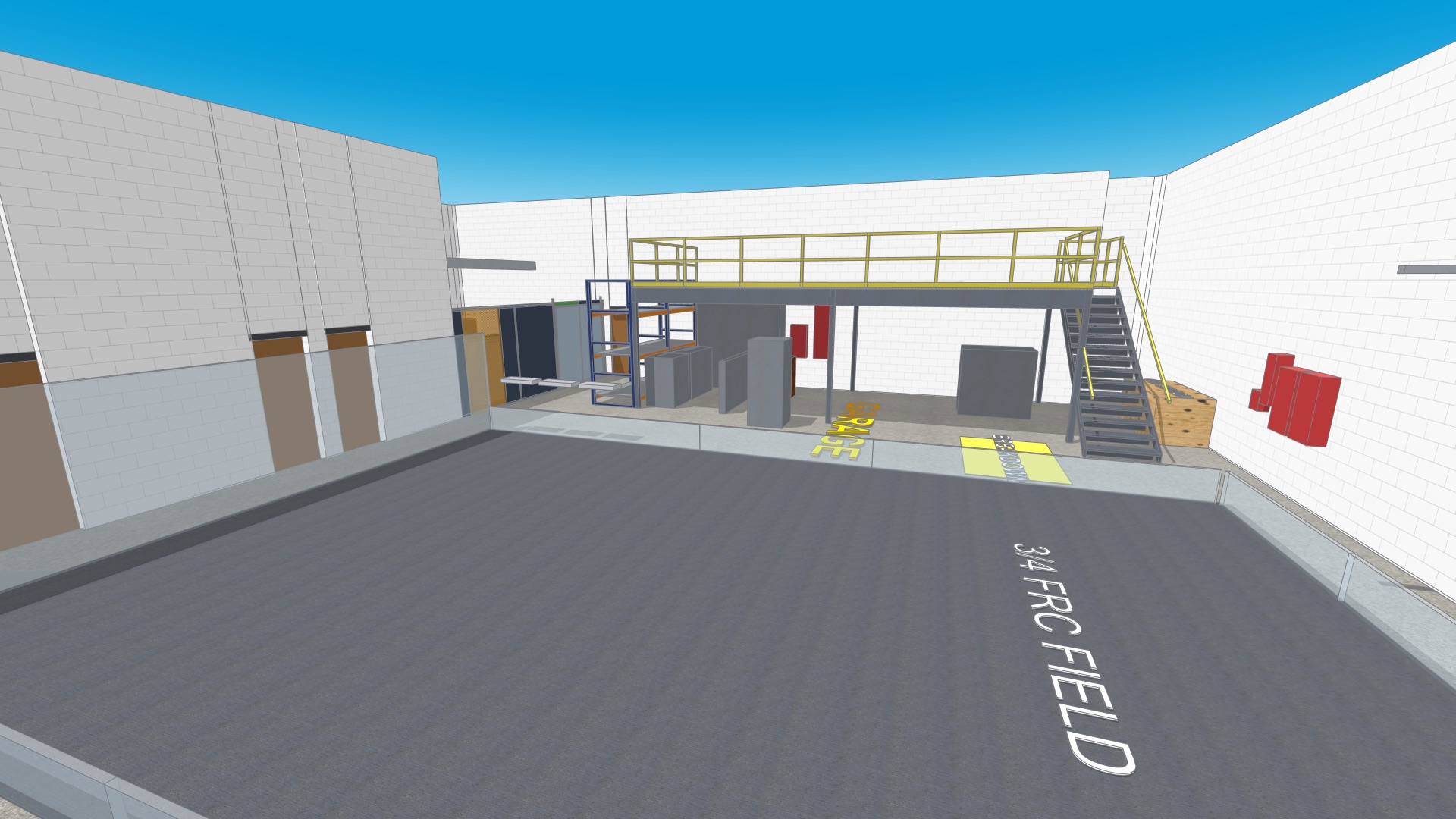
  • The garage bay is about 60 × 48 ft, roughly the 2,800 sq ft a full field with driver stations needs.
  • Mentors generally treat a little over half a field as the practical minimum. A half field fails for games that score at opposite ends. The 3/4-scale field in Option B clears that bar.
  • Across the garage, cage, Room 6, and Room 3, the lab totals about 4,300 sq ft, below the 6,500–7,800 sq ft purpose-built facilities but inside a building the district already owns.
  • FRC carpet comes in 15 ft rolls, and the border needs extra width on each side of the 27 ft field, so carpet layout should be checked on site.

What teams spend

Functional
≈ $15,000–30,000
Competitive district team that reaches Worlds
≈ $50,000–80,000
Perennial world-level program
$150,000+
TeamFigureNotes
Mentor survey of other teams$10k–80k rangeVaries with events attended, travel distance, and whether the school covers space and insurance
Unnamed competitive team$60k–80k a yearOnly $20–25k on robot parts and tools; the rest is travel, registration, and away events
195 CyberKnights≈ $58k expenses (2024)Nonprofit filing; $77.6k revenue
1678 Citrus Circuits≈ $150k a yearReported by LocalWiki Davis
5727 Omegabytes$250k+ a yearHighest-budget team cited on Chief Delphi
2713 Red Hawk Robotics$80k+ in sponsorshipsRecord season, reported in local news

What this means for Melrose

  • Red Hawk Robotics already raises money at the level of a competitive district team. Compared with peers, the gap is space, not funding.
  • The closest models (Davis, Madera, and Martin County) each got a field through a district facility. This proposal reaches a similar result by reusing a building the district already owns.
  • A field on site avoids rent, which some teams pay at about $30,000 a year, and cuts trips to shared fields such as WPI's. It also gives the district a place for scrimmages and younger FIRST programs.

What we don't know yet

  • What share of teams have a field in their school, and how space varies with enrollment. Our planned survey of U.S. teams will ask both.
  • Massachusetts funding routes for school facilities, such as state school building or CTE grants.
  • Facility details for several other top teams, including 254, 2056, 4414, and 1538.